Choosing among the 2026 top types of beauty devices requires more than comparing prices or attractive product photos. Clinics, salons, and distributors must examine the supplier behind each device. The real challenge is understanding how to find a reliable beauty device supplier before placing an expensive order.
Quality does not happen by accident.
Quality-management expert Joseph M. Juran used this principle to explain why dependable results require controlled processes. His words apply directly to beauty-device sourcing. A trustworthy supplier should provide clear specifications, product testing records, user manuals, warranty terms, and responsive technical support. Ask where the device is manufactured. Check whether the factory follows documented quality procedures. Request sample units when possible, then inspect the screen, handpiece, cable connections, packaging, and safety instructions.
Small details matter. A loose connector may reveal weak production control. Slow replies may suggest poor after-sales support. However, these signs are not always conclusive. That is where careful judgment becomes necessary. A polished website can still mislead, while a smaller manufacturer may offer stronger communication and better customization. Do not rely on one certificate, one recommendation, or one video demonstration.
A practical supplier review should combine factory evidence, independent customer feedback, product testing, and written agreements. Confirm delivery schedules and replacement procedures before making payment. Compare technical claims with real operating results. If a supplier avoids direct questions, pause. Reliability should be visible in both documents and daily communication. The process is not perfect, but disciplined checking reduces avoidable risk and supports safer, more consistent beauty-service outcomes.
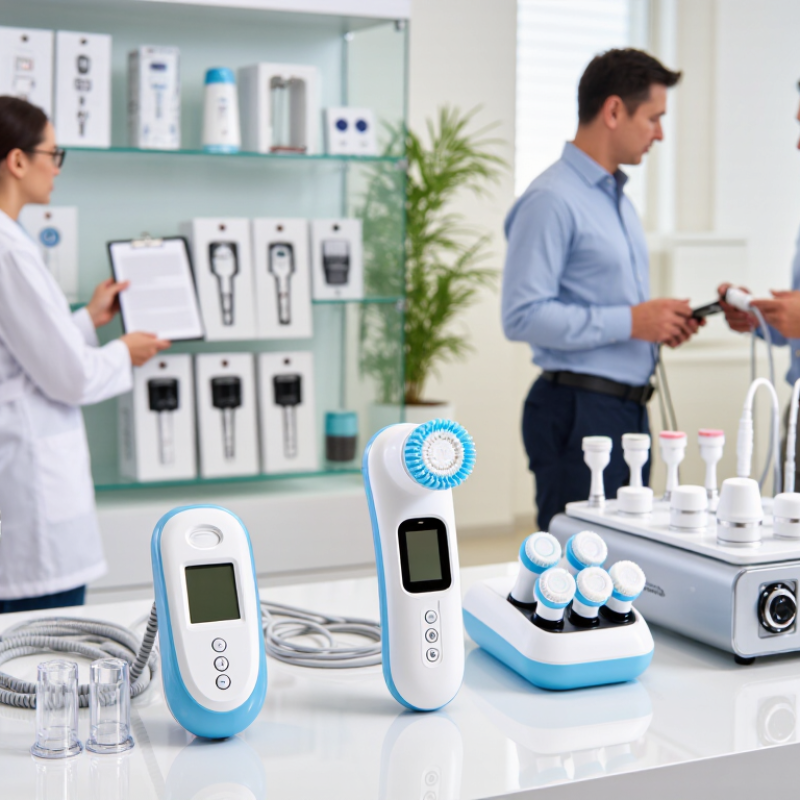
The beauty device market is expanding, but supplier quality remains uneven. McKinsey’s 2023 beauty report expects the global beauty market to approach $580 billion by 2027, with technology supporting at-home routines. This growth creates several supplier types worth considering.
OEM and ODM manufacturers suit companies needing customized devices, packaging, or user instructions. Their engineers can adjust power settings, materials, and production volumes. Specialized distributors offer faster access to tested product lines and regional stock. They may also provide training, spare parts, and basic after-sales service. Contract manufacturers are useful for regulated production environments. They usually maintain stronger documentation, batch records, and quality procedures.
A practical audit should examine factory photos, sample units, test reports, warranty terms, and response times. Ask for evidence, not promises. Intertek’s 2024 consumer product safety research highlights traceability and documented testing as essential risk controls. UL Solutions also emphasizes verification throughout connected product development. These points matter for devices using heat, light, or electrical current.
Online trading platforms can reveal many options, but a polished catalog proves little. I would request a live video inspection and an independent sample test. No supplier type is perfect. Smaller factories may communicate better but lack backup capacity. Large suppliers may offer stability but respond slowly. That trade-off deserves careful reflection before signing a contract.
A reliable beauty device supplier should prove performance, safety, and consistency with clear evidence. Do not rely on a polished catalog alone. Request product specifications, test reports, material details, and quality-control records for each device type. Confirm whether testing comes from an independent laboratory. Check whether the reports match the exact model and production version.
My supplier evaluations include factory audits, sample testing, and questions about batch traceability. A dependable supplier can explain how devices are inspected before shipment. They should also provide user instructions, maintenance guidance, and responsive technical support. Ask about defect rates and replacement procedures. Honest answers matter. Vague promises do not.
Tips:
Order samples before large purchases. Test controls, heat, noise, packaging, and daily usability. Compare two production batches if possible. Check certificate dates and issuing organizations. Speak with recent business customers, not only listed references. I once trusted a detailed presentation too quickly; the first sample exposed uneven assembly. That mistake reminded me to inspect evidence, not appearance. A supplier may pass one review and still need regular monitoring.
2026 Top Types: How to Find a Reliable Beauty Device Supplier
Grand View Research estimated the global beauty devices market at about USD 35.7 billion in 2023. Rapid growth attracts capable manufacturers and careless suppliers. Quality verification must begin with documents, not attractive packaging. Ask for the legal manufacturer, production address, intended use, and risk classification. Confirm that the ISO 13485 certificate covers the actual factory and product category. The ISO Survey 2023 reported 37,756 valid ISO 13485 certificates worldwide. A certificate still needs independent verification.
Request complete test reports from laboratories accredited to ISO/IEC 17025. For electrical devices, check applicable safety, electromagnetic compatibility, and photobiological safety tests. Review model numbers, test dates, sample conditions, and laboratory signatures. Do not accept a generic report. Test a production sample independently, then compare its serial number with batch records. Important evidence includes incoming inspection records, calibration logs, complaint handling, corrective actions, and recall procedures. Small details matter.
Regulatory status requires careful reading. FDA establishment registration or device listing does not equal FDA approval. For European sales, review the declaration of conformity, technical documentation, and notified-body evidence when required. Marketing claims can change the regulatory category. “Medical-grade” is not enough. A supplier may pass one audit and still drift later. I would schedule follow-up inspections and random batch testing. That costs more, but weak traceability costs far more. Supplier promises are useful. Verifiable records are better.
| Verification Dimension | What to Check | Reliable Evidence | Practical Acceptance Benchmark | Verification Method | Typical Risk if Missing | Priority |
|---|---|---|---|---|---|---|
| Supplier Type and Capability | Whether the supplier is an original equipment manufacturer, original design manufacturer, contract manufacturer, authorized distributor, or trading company. | Legal registration information, manufacturing-site address, production-process description, equipment list, and independently verifiable customer references. | The supplier’s legal entity, production location, and contracting entity should be clearly identified and consistent across documents. | Compare company records, factory information, purchase contracts, invoices, and audit documents. | Unclear accountability, inconsistent quality, limited technical support, or unauthorized product changes. | High |
| Quality Management System | Formal control of design, purchasing, production, inspection, complaints, corrective actions, and document changes. | Valid ISO 9001 certificate for general quality management or ISO 13485 certificate when the product and market require a medical-device quality system. | Certificate scope should cover the relevant product category and manufacturing site; certificate status should be current and independently verifiable. | Check the certificate number, scope, site address, expiry date, certification body, and accreditation status. | Uncontrolled processes, weak traceability, repeated defects, and delayed corrective actions. | High |
| Product Classification | Whether the device is a cosmetic appliance, wellness product, electrical equipment, or medical device based on intended use, claims, and mode of action. | Written intended-use statement, labeling, claims matrix, risk classification rationale, and market-specific regulatory assessment. | Marketing claims, technical specifications, labeling, and regulatory pathway should describe the same intended purpose. | Review product claims and intended use against the applicable laws and guidance in each target market. | Illegal medical claims, incorrect registration route, customs delays, recalls, or sales restrictions. | Critical |
| Technical File and Design Control | Design inputs, design outputs, verification, validation, change control, software documentation, and essential performance requirements. | Technical file index, product specifications, drawings, bill of materials, test reports, risk-management file, and design-change records. | Documents should be version-controlled, internally consistent, and linked to the exact model and revision supplied. | Conduct a document review and sample-based audit of design records before signing a long-term contract. | Unapproved component substitutions, undocumented changes, performance drift, and difficult root-cause analysis. | High |
| Electrical Safety | Protection against electric shock, overheating, fire, abnormal operation, and mechanical hazards for powered devices. | Laboratory test report against the applicable edition of IEC 60335-1 for household appliances or IEC 60601-1 for applicable medical electrical equipment. | The tested model, power rating, accessories, and firmware should match the production configuration. | Confirm laboratory competence, report scope, test samples, deviations, and model numbers; retest after major design changes. | Electric shock, overheating, fire, malfunction, or non-acceptance by a regulator or marketplace. | Critical |
| Optical and Light Safety | Risk from LEDs, intense pulsed light, lasers, ultraviolet radiation, and other optical energy sources. | Photobiological safety assessment based on IEC 62471; laser products may also require the applicable IEC 60825-1 assessment. | Risk group, emission level, wavelength, pulse parameters, protective features, warnings, and user instructions should be documented. | Review optical test data, protective eyewear specifications, interlocks, exposure limits, and labeling. | Eye or skin injury, inadequate warnings, product liability exposure, and market-access problems. | Critical |
| Biocompatibility and Materials | Safety of materials that contact skin, mucous membranes, or damaged skin during the intended duration of use. | Material specifications, supplier declarations, skin-contact assessment, and applicable ISO 10993 test reports for medical-device applications. | All skin-contact materials should be identified and controlled; test conclusions should match contact type and duration. | Compare the bill of materials with test samples and request change-notification controls for skin-contact parts. | Skin irritation, sensitization, allergic reactions, contamination, or product complaints. | High |
| Electromagnetic Compatibility | Resistance to electromagnetic interference and control of emissions that could affect other equipment. | EMC test report under the applicable product standard; medical electrical equipment may require IEC 60601-1-2 testing. | Test configuration should include the final power supply, cables, accessories, operating modes, and software version. | Check radiated and conducted emissions, immunity results, test setup, deviations, and corrective actions. | Unexpected shutdown, inaccurate output, interference with nearby equipment, or failed market testing. | High |
| Risk Management | Identification, evaluation, mitigation, and monitoring of hazards throughout the product life cycle. | Risk-management file aligned with ISO 14971 for applicable medical devices, including hazard analysis, control measures, and residual-risk evaluation. | Every significant hazard should have a documented control, verification evidence, and corresponding user information. | Trace hazards to design controls, test results, warnings, complaints, and post-market monitoring activities. | Unrecognized hazards, weak warnings, incomplete validation, and increased liability after an incident. | Critical |
| Regulatory Documentation | Market-specific registration, listing, declaration, certification, or conformity-assessment requirements. | Declaration of conformity, applicable technical documentation, registration or listing evidence, and authorized-representative details where required. | Documents should identify the exact legal manufacturer, product family, model numbers, intended use, and target market. | Verify records through the relevant government or notified-body database where available; do not rely solely on a logo or PDF. | Import rejection, listing suspension, enforcement action, or inability to sell legally. | Critical |
| Restricted Substances and Environmental Compliance | Control of restricted substances in electrical and electronic components, packaging, and materials. | RoHS test report or supplier declaration where applicable, REACH substance information, and material declarations for relevant components. | Evidence should cover the complete product, cables, adapters, batteries, packaging, and high-risk materials. | Match reports to the bill of materials and request updated evidence after component or supplier changes. | Customs problems, marketplace removal, environmental penalties, and costly component replacement. | Medium to High |
| Battery and Charging Safety | Battery cell quality, charging control, thermal protection, transport compliance, and abuse protection. | Battery specifications, UN 38.3 test summary for lithium-battery transport, IEC 62133-2 evidence where applicable, and charger test records. | Battery model, protection circuit, charger, firmware limits, and transport documents should correspond to the supplied configuration. | Review battery test summaries, production samples, charging tests, overheating protection, and packaging controls. | Fire, swelling, shipment refusal, overheating, shortened service life, or serious safety incidents. | Critical |
| Factory Process Control | Incoming inspection, in-process controls, final inspection, calibration, cleanliness, and operator training. | Inspection plans, work instructions, calibration certificates, training records, process-capability data, and nonconformance reports. | Critical-to-quality characteristics should have defined limits, inspection methods, responsible personnel, and retained records. | Perform a remote or on-site audit and observe actual production rather than reviewing documents only. | High defect rates, inconsistent output, false pass results, and poor repeatability between batches. | High |
| Independent Pre-Shipment Inspection | Whether finished products meet agreed specifications before shipment. | Sampling inspection report, functional test results, cosmetic inspection records, serial-number list, and photographic evidence. | Use a written inspection protocol with agreed critical, major, and minor defect definitions; acceptance limits should be set before inspection. | Inspect a random sample from the finished lot and confirm model, accessories, labeling, packaging, and basic functions. | Defective products reach customers, returns increase, and warranty costs become difficult to control. | High |
| Traceability and Serial Control | Ability to trace products, components, firmware, production dates, and quality records. | Serial-number structure, batch records, component-lot records, software-version records, and complaint traceability procedure. | Each unit or batch should be traceable to production date, site, key components, inspection status, and shipped customer order. | Choose several serial numbers and trace them backward to production and forward to shipment records. | Slow recalls, inaccurate investigations, counterfeit exposure, and inability to isolate affected batches. | High |
| Software and Cybersecurity | Firmware reliability, update control, access control, data protection, and security of connected functions. | Software version history, verification records, vulnerability process, update policy, access-control design, and privacy documentation. | Production firmware should be version-controlled, tested, recoverable, and protected against unauthorized changes. | Test updates, account permissions, reset behavior, data collection, fault handling, and support for security issues. | Device malfunction, unauthorized access, personal-data exposure, and regulatory or contractual disputes. | High |
| Warranty and Corrective Action | Post-sale support, defect reporting, replacement policy, root-cause analysis, and corrective-action response time. | Written warranty terms, complaint procedure, corrective-action template, service-level agreement, and spare-parts policy. | Responsibilities, response times, defect thresholds, replacement terms, and escalation procedures should be contractually defined. | Review sample complaint cases and include audit rights, recall cooperation, and change-notification obligations in the contract. | Unresolved customer complaints, hidden recurring defects, high service costs, and reputational damage. | High |
Finding a reliable beauty device supplier in 2026 requires more than comparing unit prices. A low quote may exclude packaging, testing, shipping, or replacement parts. Request a detailed invoice with every cost listed. Compare identical specifications, such as power, treatment settings, included accessories, and expected lifespan. A cheaper device is not always the better investment.
Service quality deserves equal attention. Ask how quickly the supplier answers technical questions and handles damaged units. Review warranty terms carefully, including repair timelines and shipping responsibilities. Request a sample before placing a large order. Test its controls, packaging, instructions, and performance under normal working conditions. A comparison sheet is rarely perfect. Hidden costs can still appear later.
Tips: Compare minimum order quantities, not just prices. Ask whether mixed models count toward the MOQ. Confirm production time in writing. Check quality records, safety documents, and inspection procedures. Speak with a real representative, not only an automated chat. Keep notes from every supplier conversation. I would also negotiate carefully; pushing for the lowest price may reduce support, customization, or consistency. Reliability often costs slightly more, but unclear service costs more later.
In 2026, choosing a beauty device supplier requires more than comparing prices. Your supplier should understand your target customers, product category, and sales channels. Ask about manufacturing experience with similar devices. Request factory photos, production records, and recent quality-control reports. A polished website proves very little.
Start with samples, not promises. Test charging time, heat levels, noise, packaging strength, and user instructions. Record every result in a simple evaluation sheet. Reliable suppliers should provide electrical safety reports, material information, traceability records, and documentation relevant to your target markets. Verify certificates through the issuing organization when possible. Do not accept copied files.
Communication reveals operational quality. Ask for clear answers about minimum order quantities, lead times, replacement parts, warranty handling, and inspection procedures. A dependable supplier explains delays before they become expensive. They should also support controlled product changes, because a small component change can affect performance. My first supplier comparison focused too heavily on unit cost. That was a mistake. Shipping damage and slow responses later cost more than the original savings.
Consider a paid pilot order with defined acceptance standards. Check whether the delivered units match the approved sample. Keep written records of defects, corrective actions, and response times. A supplier who welcomes reasonable audits may be easier to manage long term. Still, no supplier is perfect. Build a backup plan, review performance quarterly, and leave room for uncomfortable questions.
Use this 100-point evaluation model to compare beauty device suppliers. The suggested weights prioritize regulatory evidence, product safety, and quality-system controls before capacity and service.
Check whether the supplier can provide relevant documentation for the target market and device type, such as ISO 13485 for medical-device quality management, ISO 9001 for general quality management, IEC 60601-1 for applicable medical electrical equipment, or IEC 62471 for applicable photobiological safety assessments. Requirements vary by product and destination market.
Request specifications, test reports, material details, and quality-control records. Check whether reports match the exact model and production version. Independent laboratory testing adds credibility. A polished catalog proves little.
Samples reveal uneven assembly, weak packaging, noisy controls, or unclear instructions. Test charging, heat, treatment settings, and daily usability. Test the sample. My earlier review trusted presentation too quickly. That was a mistake.
Request an invoice listing packaging, testing, shipping, accessories, and replacement parts. Compare identical power, settings, lifespan, and included items. A low quote may hide costs. Cheap is not always better.
Ask about response times, damaged units, repair timelines, warranty coverage, and shipping responsibilities. Request clear answers in writing. Slow support can cost more than a higher unit price.
Compare minimum quantities alongside price and service quality. Ask whether mixed models count toward the minimum. Confirm production time in writing. Small orders may reduce risk.
Check certificate dates, issuing organizations, and model details. Verify documents through the issuing organization when possible. Do not accept copied files. Document checking is sometimes tedious.
Ask how component changes are controlled and communicated. A small change can affect heat, noise, charging, or performance. Require approval samples before production changes. Keep written records.
Track defects, batch details, corrective actions, response times, and delivered samples. Compare different production batches when possible. Review performance quarterly. No supplier is perfect. Keep a backup plan.
Finding the right supplier is essential for building a successful beauty device business in 2026. This guide explains how to find a reliable beauty device supplier by comparing different supplier types, including manufacturers, wholesalers, trading companies, and specialized distributors. It highlights important evaluation standards such as production experience, communication, customer support, delivery reliability, and business transparency.
The article also outlines practical ways to verify product quality, testing records, safety documentation, and regulatory compliance before placing an order. It covers how to compare prices, customization services, warranties, shipping terms, payment conditions, and minimum order quantities. Finally, it provides a clear decision-making framework to help businesses select a supplier that matches their target market, budget, product requirements, and long-term growth plans.

TK Beauty