Are LED beauty devices effective? The honest answer depends on wavelength, dose, device fit, and the skin concern being treated. A red glow in a bathroom mirror is not proof of a clinical result. Some controlled studies report improvements in acne or signs of photoaging, but study sizes, treatment schedules, and devices vary. Results from a clinic cannot automatically be expected from a home mask.
A useful evidence check comes from peer-reviewed dermatology research: published reviews describe promising LED findings, while also noting inconsistent methods and limited high-quality trials. The American Academy of Dermatology likewise advises consumers to keep expectations realistic; at-home light devices may require repeated use, and visible changes can be modest. That caveat matters. Market growth is not proof of medical effectiveness. Grand View Research’s LED light therapy market report estimated a global market value of about US$1.1 billion in 2023, but commercial demand measures sales, not skin outcomes.
Photobiomodulation researcher Dr. Michael Hamblin has cautioned, “The mechanisms of photobiomodulation are not fully understood.” That uncertainty belongs in any buying guide. For China’s top 10 LED beauty devices, this article will compare stated wavelengths, treatment instructions, safety features, and the evidence behind their claims. It will not treat bright lights or impressive packaging as clinical proof. Small details matter: does the mask sit evenly across the cheeks, and can users follow its schedule consistently? Not glamorous. Still, those practical limits may shape real-world results as much as the device specifications.
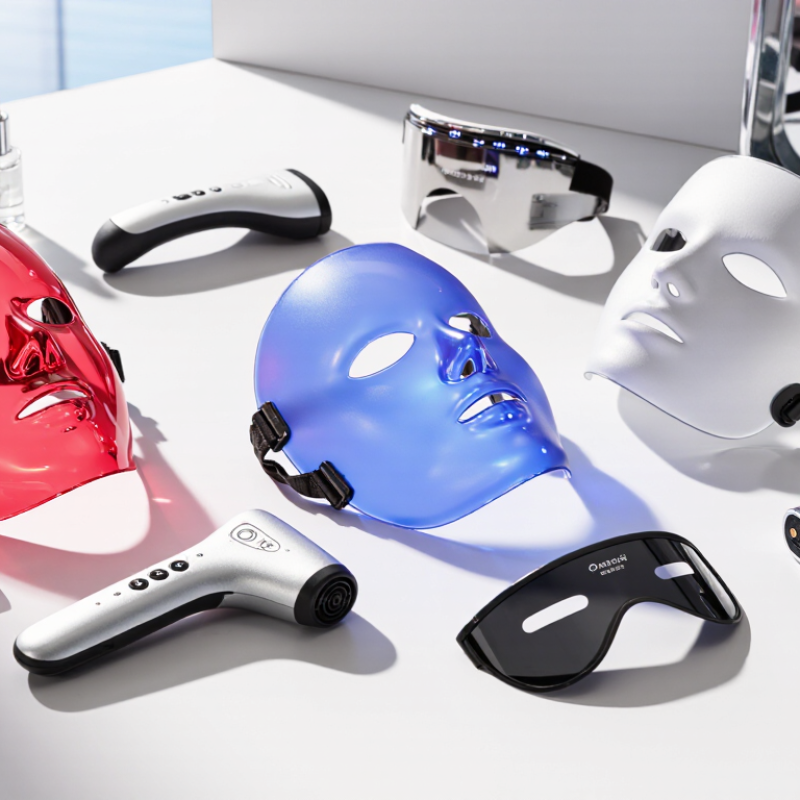
LED photobiomodulation uses selected wavelengths to influence skin processes, but color alone cannot prove a device works. Blue light near 415 nm is absorbed mainly in superficial skin and may help reduce acne-related bacteria. Red light, commonly 630–660 nm, reaches farther and may support cellular signals involved in skin repair. Near-infrared light around 810–850 nm penetrates more deeply. It is studied for tissue recovery, though home-use results vary. Not magic. Evidence varies.
A useful comparison looks beyond the wavelength label. Irradiance, treatment time, distance from skin, and consistent output all affect the delivered dose. A bright-looking panel may still provide unclear dose information. Deeper penetration does not automatically mean better facial results. Research protocols also differ from consumer-device instructions, so results cannot be assumed identical. Visible changes are more likely to be gradual and modest than guaranteed.
Tips: Follow the device’s timing and distance instructions, and protect your eyes as directed. Take photos under the same lighting every few weeks; daily mirror checks can mislead. Stop if persistent redness, discomfort, or worsening irritation occurs. People with eye conditions, photosensitivity, or medicines that increase light sensitivity should consult a qualified clinician before use. One practical limitation: product pages often omit output data needed for fair comparisons.
Blue light near 415 nm acts mainly near the skin’s surface and may help with acne-related bacteria. Red light around 630–660 nm may support skin-repair signals. Near-infrared light around 810–850 nm reaches deeper tissue. Deeper is not automatically better.
One study of 107 people found fewer inflamed acne lesions after 12 weeks of blue-red treatments. That is encouraging, not a guarantee. Home devices may deliver different doses, and LED light is not a cure.
A controlled trial with 136 participants reported improvements in fine lines and skin texture after repeated red and near-infrared treatments. The effect was modest. It does not prove lasting lifting.
Evidence for LED treatment of pigmentation is limited and mixed. Some visible light may deepen pigmentation in susceptible skin. Ask a qualified clinician about new, changing, or uneven patches.
No. Irradiance, treatment time, distance from skin, and consistent output also affect the dose. A bright panel may still provide unclear output information. That makes comparisons difficult.
Take photos every few weeks in the same lighting, from the same distance. Daily mirror checks can mislead. The change may be gradual, or hard to see.
Follow the device’s timing and distance instructions, and protect your eyes as directed. Stop if redness, discomfort, or irritation persists. People with eye conditions, photosensitivity, or light-sensitive medicines should consult a qualified clinician.
Not necessarily. Research protocols and consumer instructions can differ, so results may not match. Small studies can also miss side effects. I would treat early results cautiously.
LED beauty devices use specific wavelengths to influence skin activity: blue light around 415 nm is commonly used for acne-related concerns, red light at 630–660 nm for visible signs of aging, and near-infrared light at 810–850 nm for deeper tissue exposure. When comparing devices, wavelength alone is not enough; irradiance and delivered dose also matter. A practical benchmark is roughly 10–50 mW/cm² and 4–10 J/cm², though appropriate settings vary by device and treatment area.
So, are led beauty devices effective? Evidence suggests they may offer modest improvements in acne and wrinkles with consistent use, while results for pigmentation are less predictable. Follow the device instructions, protect your eyes, and use sessions at the recommended frequency rather than assuming more is better. Track changes with consistent photos over 8–12 weeks, and discontinue use if irritation occurs. These devices can support a skincare routine, but they are not guaranteed to work equally well for everyone.

 TK Beauty