China’s Top 10 Beauty Devices deserve more than a popularity ranking. Their performance depends on engineering, user behavior, skin condition, and responsible testing. A bright screen or elegant casing proves very little.
The central question is: what factors affect beauty device performance? Light-based tools rely on wavelength, energy density, pulse duration, and consistent skin contact. Microcurrent devices require stable electrode placement and sufficient conductivity. Radiofrequency models depend on temperature control, treatment time, and even movement across the skin.
Small details matter.
A device may feel warm, yet deliver uneven energy. A mask may appear powerful, but fit loosely around the cheeks. Batteries can weaken, electrodes can oxidize, and sensors can drift after repeated use. These issues may reduce results without obvious warning signs.
Board-certified dermatologist Dr. Zoe Diana Draelos has explained the practical principle this way: “The best device is the one that is matched to the patient and used correctly.” This view keeps marketing claims in perspective. Performance should be judged through transparent specifications, user instructions, safety testing, and realistic clinical evidence.
Skin type changes the outcome. So does age, hydration, treatment frequency, and previous sensitivity. A trained professional may recognize risks that a product page overlooks. Still, home users need clearer information than vague promises.
This article compares ten leading beauty devices in China through measurable factors. It examines energy delivery, usability, maintenance, comfort, and evidence quality. The ranking is not absolute. That matters.
A device that performs well in a laboratory may disappoint in a humid bathroom. Real-world consistency remains the difficult test.
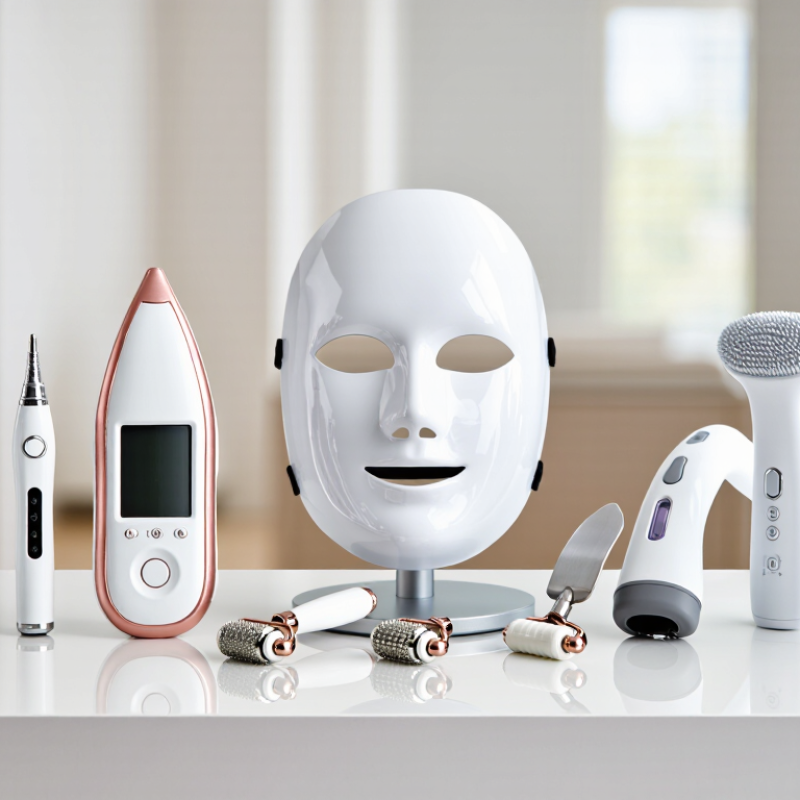
China’s top ten beauty devices are better defined by energy type and intended use than by popularity. The group includes LED phototherapy, radiofrequency, microcurrent, EMS, ultrasound, IPL, low-level laser, galvanic iontophoresis, cooling devices, and mechanical vibration tools. Each works differently. LED uses selected wavelengths for surface-level skincare routines. Radiofrequency and ultrasound deliver deeper thermal energy. IPL and laser rely on controlled light absorption. Microcurrent and EMS focus on electrical stimulation, while cooling and vibration mainly support comfort and massage.
Performance depends on wavelength, output, treatment time, skin contact, and temperature control. A 2024 Fortune Business Insights report valued the global aesthetic devices market above US$15 billion in 2023. Its growth reflects demand for non-invasive technologies, but market size does not prove effectiveness. Grand View Research also identifies energy-based systems as a major growth area. Still, consumer devices usually deliver lower energy than professional equipment. Results can vary sharply.
Tips: Match the device to one clear use. Check irradiance, frequency, pulse duration, and safety testing. For example, uneven contact can reduce radiofrequency heating. Excessive use may irritate the skin. Read the operating instructions carefully. Look for evidence based on measurable outcomes, not only user photographs. IEC 60601 safety principles can provide useful technical context, although they do not guarantee cosmetic results. The ranking remains imperfect. Real-world performance depends on protocol, maintenance, and user consistency.
| No. | Beauty Device Category | Energy Type | Typical Technical Parameters | Primary Cosmetic Use | Main Factors Affecting Performance | Key Limitations and Safety Considerations |
|---|---|---|---|---|---|---|
| 1 | LED Phototherapy Device | Visible light Near-infrared light | Red light is commonly around 620–660 nm; near-infrared light is commonly around 810–850 nm; blue light is commonly around 405–430 nm. Irradiance and treatment duration vary by design. | Support for acne-prone skin, temporary reduction of inflammation, and improvement in the appearance of fine lines. | Wavelength accuracy, irradiance at the skin surface, total energy dose, treatment distance, uniformity of light distribution, treatment frequency, and consistent skin contact or positioning. | Results are gradual and protocol-dependent. Blue light may irritate sensitive skin, and photosensitizing medicines can increase light sensitivity. |
| 2 | Radio-Frequency Skin Tightening Device | Radio frequency Electrical energy | Common operating frequencies include approximately 0.5–2 MHz. Controlled dermal heating is often targeted in the approximate range of 40–43°C at the skin surface, depending on the device and protocol. | Temporary improvement in the appearance of mild skin laxity, fine lines, and uneven texture. | Frequency, electrode configuration, impedance matching, contact pressure, conductive gel, temperature control, energy delivery uniformity, skin thickness, and number of sessions. | Excessive heat may cause burns or unwanted fat changes. Use requires caution around implanted electronic devices and metal implants. |
| 3 | Intense Pulsed Light Device | Broad-spectrum pulsed light | Filtered broadband light is commonly delivered within approximately 500–1,200 nm. Performance depends on fluence, pulse duration, pulse delay, spot size, and cooling. | Reduction in the appearance of unwanted hair, selected pigmentation, and superficial redness. | Wavelength range, fluence, pulse width, skin tone, hair color and thickness, treatment area, cooling system, optical window contact, and operator settings. | Darker or recently tanned skin has a higher risk of burns and pigmentary changes. Eye protection is essential; results vary considerably by hair and skin characteristics. |
| 4 | Diode Laser Hair-Removal Device | Semiconductor laser Near-infrared light | Common diode laser wavelengths include approximately 800–810 nm. Fluence, pulse width, repetition rate, spot size, and contact cooling are key operating variables. | Long-term reduction of unwanted hair through selective heating of melanin in the hair follicle. | Wavelength, fluence, pulse duration, cooling, hair growth cycle, hair diameter, melanin concentration, skin tone, and treatment interval. | It is less effective on white, gray, or very light hair. Incorrect settings can produce burns, blistering, or temporary pigment changes. |
| 5 | Microcurrent Facial Device | Low-level direct current Electrical stimulation | Consumer devices commonly operate in the microampere range, often approximately 50–500 µA, although specifications differ substantially between devices. | Temporary improvement in the appearance of facial contours and muscle tone. | Current amplitude, waveform, electrode contact, conductive medium, polarity, treatment duration, skin hydration, and consistent treatment technique. | Visible effects may be temporary. Avoid use over implanted electronic devices and follow restrictions related to pregnancy, epilepsy, and certain medical conditions. |
| 6 | Ultrasonic Skin Scrubber | Mechanical ultrasound | Many spatula-style devices use ultrasonic vibration in the approximate range of 20–30 kHz. Moisture on the skin is generally required for effective operation. | Surface cleansing, removal of loose corneocytes, and temporary improvement in skin smoothness. | Vibration frequency, blade angle, contact pressure, skin wetness, movement speed, treatment duration, and cleanliness of the spatula. | It does not replace professional extraction or medical acne treatment. Excessive pressure or frequent use may cause irritation and barrier disruption. |
| 7 | Galvanic Facial Device | Low-voltage direct current Iontophoresis | Devices commonly use low-intensity direct current, often below approximately 2 mA, with positive and negative polarity modes. | Product-assisted cleansing and delivery of compatible water-soluble cosmetic ingredients through iontophoresis. | Current intensity, polarity, product conductivity, molecular charge, electrode contact, skin hydration, treatment duration, and formulation compatibility. | Cosmetic ingredient penetration is formulation-dependent and not guaranteed. Avoid use with implanted electronic devices or on damaged skin. |
| 8 | High-Intensity Focused Ultrasound Device | Focused ultrasound Acoustic energy | Facial systems may use focal depths such as approximately 1.5, 3.0, and 4.5 mm. Frequency and acoustic intensity vary by device and treatment depth. | Non-surgical improvement in the appearance of skin laxity and facial contour. | Focal depth, acoustic energy, shot spacing, coupling medium, transducer alignment, treatment mapping, skin thickness, and operator training. | Incorrect placement may cause pain, nerve irritation, burns, or unwanted tissue injury. Professional assessment is important for facial treatment. |
| 9 | Cryolipolysis Body-Contouring Device | Controlled cooling Thermal energy transfer | Applicator temperatures may reach approximately −5 to −10°C in some systems, but actual cooling profiles depend on applicator design, tissue contact, and control algorithms. | Non-surgical reduction of localized subcutaneous fat bulges in selected body areas. | Cooling temperature, exposure time, applicator fit, tissue thickness, vacuum pressure, treatment area, protective membrane, and individual response. | Possible effects include numbness, bruising, pain, and contour irregularities. It is not a weight-loss treatment and is unsuitable for some cold-related disorders. |
| 10 | Microdermabrasion Device | Mechanical abrasion Vacuum pressure | Systems may use diamond tips or aluminum-oxide crystals combined with adjustable vacuum suction. Pressure and vacuum levels vary by device. | Exfoliation of the outer stratum corneum and temporary improvement in skin smoothness and brightness. | Abrasive material, tip roughness, vacuum level, number of passes, contact pressure, skin condition, sanitation, and post-treatment care. | Over-treatment may cause redness, irritation, or post-inflammatory pigmentation. Avoid use on active infections, open wounds, or severely inflamed skin. |
Note: Technical ranges are representative industry values rather than specifications for a particular product. Actual performance depends on device calibration, treatment protocol, operator technique, skin characteristics, and compliance with applicable safety requirements.
Check wavelength, irradiance, coverage, heat, battery stability, and LED spacing. Appearance alone proves very little.
It is commonly studied for blemish-prone skin. Results depend on delivered energy, exposure time, and distance.
Not automatically. Excessive exposure may increase discomfort, especially near the eyes. Follow the stated schedule.
It may support a more even-looking complexion and smoother-looking skin. Results vary with age, skin condition, and habits.
Use a calibrated spectrometer for wavelength and a radiometer for output at skin level. Marketing claims need measurement.
Inspect LED spacing, treatment coverage, battery stability, and heat after ten minutes. Weak thermal control can affect comfort.
Lower frequencies may distribute energy more deeply, while higher frequencies may create localized warming. Frequency alone cannot predict depth.
Around 1 MHz may reach deeper tissue, while 3 MHz is absorbed closer to the surface. Intensity and gel also matter.
Keep the applicator moving steadily and use enough coupling medium. Test a small area first.
Stop unusual heat, pain, or persistent redness. A qualified professional should review instructions and personal safety factors. My comparison remains imperfect.
China’s top 10 beauty devices can be evaluated by their energy type, intended use, and technical performance. LED devices depend on wavelength, with blue light around 415 nm commonly selected for surface-focused applications and red light between 630 and 660 nm used for deeper light exposure. RF and ultrasound devices are influenced by operating frequency: RF systems may work around 0.5–2 MHz, while ultrasound devices often use 1–3 MHz, affecting energy penetration, treatment sensation, and consistency. IPL performance is shaped by its broad 400–1,200 nm spectrum, as well as fluence, pulse control, and energy distribution.
So, what factors affect beauty device performance? Key factors include wavelength accuracy, frequency stability, output power, energy uniformity, treatment settings, skin-contact design, and user operation. Safety and quality are equally important. Applying IEC 60601-1 principles and maintaining an ISO 13485-based quality system can support electrical safety, manufacturing consistency, risk control, and reliable device performance.

 TK Beauty